Safe Relocation of Art
Artwork is often most vulnerable in transit, especially when handled by someone without packing experience. This guide shares practical, real-world tips for moving a single two-dimensional artwork (painting, framed work on paper, etc.) in a personal vehicle using common household materials—blankets, trash bags, towels, pillows, and floor mats. These recommendations are guidelines only and cannot protect the artwork in a serious accident.
Start With Fit and Planning
Before you leave—whether transporting art from home or picking up a new acquisition—measure the artwork and your vehicle space (trunk, back seat opening, SUV cargo area). Remember: artwork dimensions listed on invoices or catalogs are often the image size, not the overall framed size. If picking up from a gallery, call ahead for the exact outside dimensions (and even the packed size) so you don’t arrive and discover it won’t fit. Let the gallery know where you plan to place the work so they can pack it appropriately.
Think Safety First
Ask yourself: if you brake hard, swerve, or get hit, will the artwork become a projectile? Remove loose items (golf clubs, gym bags, tools, etc.) from the area where the art will ride. Avoid traveling with pets; if you must, make sure they cannot access the artwork—animals can scratch or puncture an unprotected canvas quickly.
Know the Artwork Type and Handle Accordingly
Works on paper are often hinged inside the frame; they must be transported so the “top” stays up, or the work can tear its hinges (“slip its hinge”). If the piece is wrapped in an opaque bag or blanket, clearly mark TOP and FRONT.
Unglazed oil on canvas is vulnerable to abrasion and paint loss. Avoid placing blankets directly over the face; blanket movement can cause fragile paint or impasto to flake and can stress the canvas.
Best Vehicle Options
Trunk Transport (Often the Best Choice)
If the trunk is empty, dry, and not too hot or cold, the carpeted trunk is usually ideal because it’s separated from passengers and reduces shifting.
- Unglazed artwork – Place a blanket flat on the trunk floor, set the artwork on it, then roll the blanket edges inward like a “jelly roll” to create padded side barriers. Position the artwork so the far edge rests against the trunk’s forward wall (near the back seat) to reduce sliding during sudden stops. Do not cover an unglazed canvas with a blanket.
- Glazed artwork (glass) – A blanket can be used beneath and around the piece, and a soft blanket can be placed over it if needed. Remove any over-blanket before lifting the work so you carry it upright.
- Glazed artwork (plexiglass) – Use a plastic bag first, then a blanket if needed—blankets can scratch plexi.
- Carrying tip – Always carry a work upright, facing you, with two hands on the sides. Avoid lifting by the top edge or hanging wire.
Back Seat Transport (When Trunk Won’t Work)
This is less ideal but sometimes necessary. Drive cautiously “like you have a baby in the back seat.”
- Small works – Best placed on the floorboard, angled so the bottom rests against the back of the front seat and the top leans against the front of the rear seat. Use a floor mat, rolled towel, or clothing as a buffer so the frame doesn’t rub hard parts under the seat.
- Medium works between front and back seats – Plan for four key contact points:
Back seat contact: Watch for exposed hardware/wires that can damage upholstery. Use a towel or blanket as a shield.
Bottom edge/console contact: Protect the frame where it meets hard plastic or metal using a mat/towel. If resting on the drivetrain hump, brace corners with rolled towels to keep it stable.
Front (face) protection: In a sudden stop, the artwork may move forward. If possible, add a stiff protective layer (foam board/cardboard) or, at minimum, stabilize with blankets. For glass, padding helps contain shards if breakage occurs.
Side protection: After positioning, test door clearance with windows down. If there’s room, wedge pillows/blankets at the sides (through open windows before rolling them up) to prevent lateral shifting during turns.
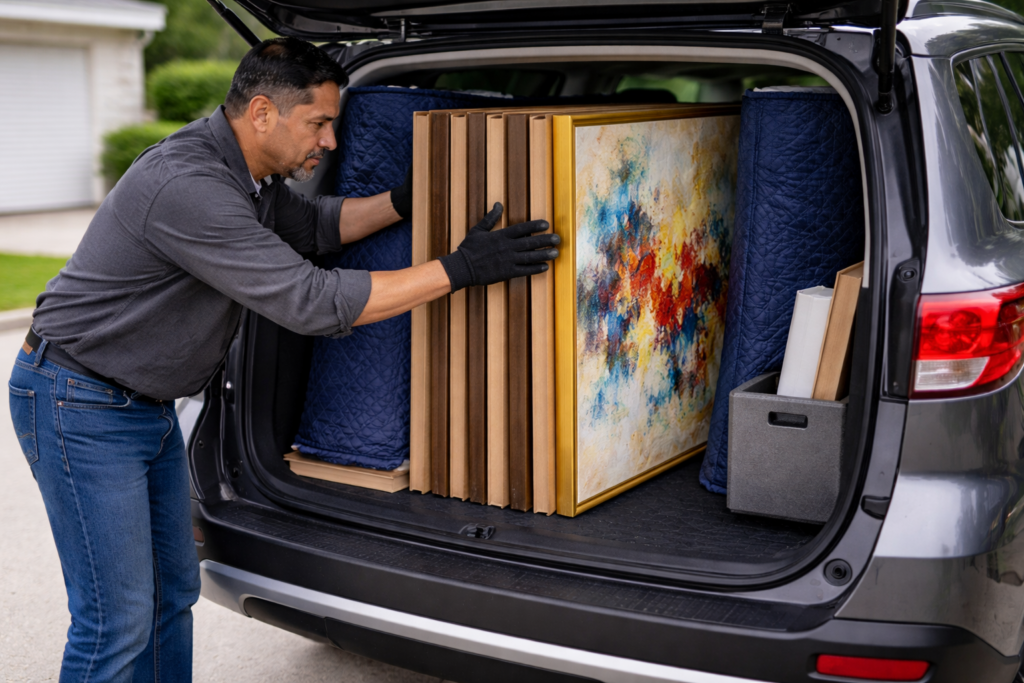
SUV Transport (Large Works Laid Flat)
With back seats down, placing a work flat on its back reduces stress on the frame and artwork. Record your SUV’s usable cargo dimensions for future reference.
Place the artwork so the frame edge touches the back of the front seats to prevent forward slide during braking. Roll blanket edges up around the frame for side protection and use another blanket behind the work to reduce sliding during acceleration. Keep the cargo area free of loose objects that could slide onto the artwork.
Covering (if you need concealment):
- Glass: a blanket can work.
- Plexiglass: use a sheet (less scratching).
- Dry unglazed canvas: a light plastic drop cloth can work—lift off carefully; don’t drag it across the surface.
Professionals
Professionals use tall specialty vans that secure the art in an upright position with ample protection to ensure it arrives safely to the storage climate controlled facility or back to the home.
Get quotes from professional art handlers. They carry proper insurance, experience, materials (stiff boards, foam core, separators) and know how to secure art safely. Furniture movers often rely only on blankets and stretch wrap—fine for furniture, risky for fragile art (especially unglazed works).
Key Takeaways
- Artwork is highly vulnerable during transport and requires careful preparation.
- Measure both the artwork and vehicle space before transport.
- Use household materials like blankets and pillows for basic protection.
- Keep artwork secure to prevent movement during driving.
- Remove loose objects and keep pets away from the transport area.
- Trunks are generally the safest location for transport when conditions allow.
- Avoid placing heavy coverings directly on unglazed canvases.
- Protect all contact points when transporting artwork in a back seat.
- Use rigid materials when possible for better support and protection.
- Consider professional transport services for valuable or fragile pieces.
This article is based partly on this postings.