Appraiser Qualifications and the Appraisal Process
Because no license is required to appraise personal property, collectors must be careful when selecting an art appraiser. The most reliable way to ensure competence and ethical practice is to hire an appraiser who is a member of one of the three major professional organizations: the International Society of Appraisers (ISA), the Appraisers Association of America (AAA), or the American Society of Appraisers (ASA).
Appraiser Qualifications and Certification
- Qualified members of these organizations must complete formal education in appraisal methodology and pass the Uniform Standards of Professional Appraisal Practice (USPAP) course, which establishes the ethical and performance standards for the appraisal profession. USPAP training must be refreshed every two years.
- Certification represents the highest level of qualification. Certified appraisers have completed advanced coursework, passed rigorous exams, and documented substantial real-world appraisal experience. For example, ISA-certified appraisers must demonstrate at least 200 hours of appraisal work, pass a comprehensive exam, submit a sample appraisal for peer review, and requalify every five years. Hiring a certified appraiser provides confidence that the appraisal will be credible, defensible, and compliant with professional standards.
- Beyond credentials, collectors should evaluate an appraiser’s education and experience. A background in art history and hands-on experience in museums, galleries, or auction houses are critical. Among equally credentialed appraisers, experience and subject-matter expertise are the most important differentiators.
Determining Whether an Appraisal Is Needed
- When first contacted, an appraiser determines why the appraisal is needed—insurance, estate planning, donation, or sale—and explains what the client can expect.
- Initial discussions cover the artist, medium, size, documentation, prior appraisals, and how the appraisal will be used.
- If warranted, the appraiser typically conducts a free inspection to confirm the scope of work and number of items before providing a cost estimate and contract. One artwork generally requires 3–6 hours from inspection through report completion.
Inspection and Research
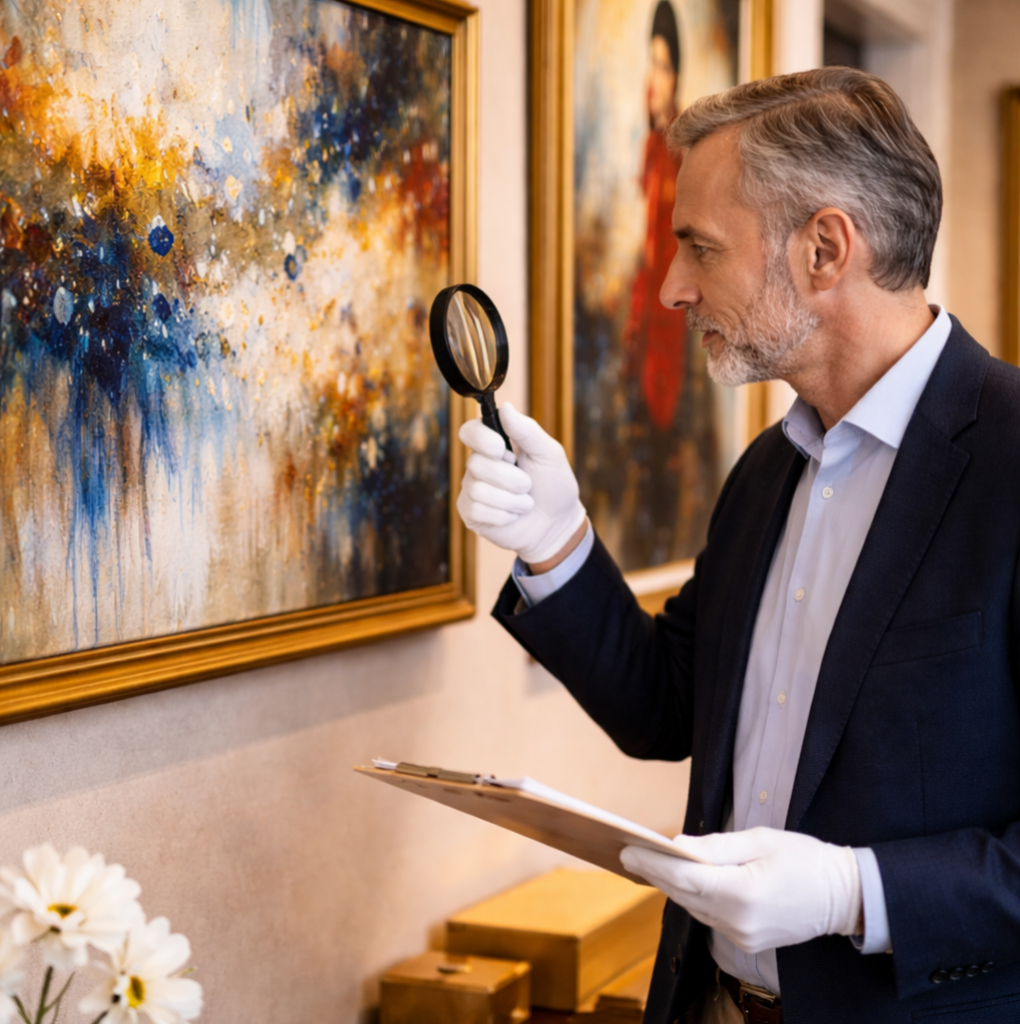
- During inspection, the appraiser examines condition, front and back, noting signatures, dates, labels, and inscriptions. The artwork is measured and photographed. Tools such as UV (black) light may be used to detect overpainting or hidden damage.
- Provenance documents, receipts, and prior reports are collected to streamline research and reduce costs.
- While prior appraisals help with identification, only current market data determines present value.
Valuation Methodology
- For insurance appraisals, valuation depends on whether the work is in the primary market (living artist, gallery sales) or secondary market (deceased artist, auction or resale).
- Primary market values are based on current gallery asking prices, while secondary market values rely on comparable auction and private sales. The most relevant market—the one the client would realistically use to replace the work—guides the analysis.
The Written Appraisal Report
- A professional appraisal includes three parts:
Cover Letter: Identifies the object, client, purpose, effective date, ownership, methodology, market context, and final value, along with required USPAP certification statements.
Body: Contains detailed descriptions, condition assessments, photographs, and comparable sales or asking prices with analysis.
Addendum: Includes scanned documentation, provenance, bibliography, and the appraiser’s CV and qualifications.
- Insurance appraisals are typically delivered as PDFs, while appraisals for federal use require signed hard copies plus a digital version.
Key Takeaways
- A qualified appraiser combines professional certification, rigorous methodology, deep market knowledge, and ethical standards.
- Selecting the right appraiser ensures accurate, defensible valuations and protects both the artwork and the collector.
This article is based partly on this posting.