Storing Art During Renovations
When work is being done in a room or the house, furniture can usually be pushed to the center and covered, but artwork needs a safer plan. If the collection includes items with emotional attachment or museum-quality works, the safest choice is to hire a professional, experienced art handling company to pack the items securely to prevent any damage and place them in bonded, climate-controlled storage.
Choose the Right Temporary Storage Space Onsite
Use a climate-controlled specialty area. If storing onsite, use a room with minimal foot traffic, often a guest bedroom. The goal is to obtain stable temperature, humidity, and airflow. Ensure the HVAC is set 1 or 2 days before moving the art to ensure the space is stable and the system is working. Keep the area closed or locked to prevent accidents.
Avoid stacking artwork directly over or in front of HVAC vents or returns. Art can be dried out, overheated, chilled, or even knocked over by airflow—especially large, light canvases.
Handle Orientation Correctly
Not all artworks can be stored in any direction:
- Oil paintings on canvas or panel can usually be stacked in any direction.
- Hinged, framed works on paper (often glazed) must be stored upright so gravity doesn’t tear the hinges (“slip the hinge”). These should never be stored sideways or upside down.
Find a wall where the largest piece fits fully, with its top edge resting cleanly against the wall. If you have many artworks, create multiple stacks—often grouping by size (large/medium/small) to reduce instability and manage weight.
Use Safe Surfaces and Keep Art Off the Floor
Water leaks happen, so don’t stack artworks directly on the floor. Raise stacks using simple risers, such as two 2×4 boards placed perpendicular to the wall and spaced so frames straddle them. Alternatively, a low folding table against the wall can work if you add a non-slip surface (e.g., a rubber-backed bath mat). If frames are fragile, add a strip of foam core or other stiff padding on top of the risers to protect delicate finishes.
If storing onsite and the room has a bed, it can be a safe place for small framed works: lay a sheet over the bedspread, place works face-up without touching, and optionally cover loosely with a thin clear plastic drop cloth so anyone entering can immediately see art is there.
Take advantage of the move to dust the backs of frames as you remove each piece from the wall.
Create an Inventory
You may need to search for a given art piece, so create an inventory of the items (index cards work well). Include identifying info plus framed height × width × depth (art is typically measured height first). Mark which pieces are hinged and must remain upright and it what direction. Confirm the wall space can accommodate the largest work in the required orientation.
Best Practice: Stack with Separator Sheets
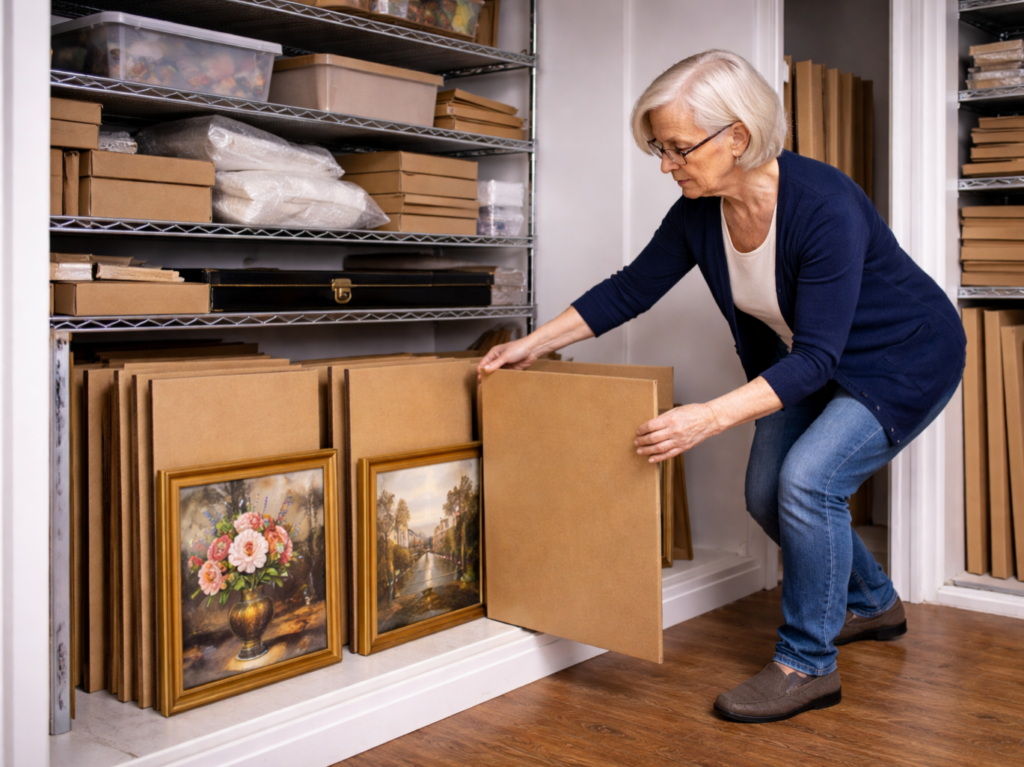
The safest temporary stacking method uses stiff separators between artworks—foam core, fluted cardboard, or rigid insulation board. Each separator should be larger than the artwork it protects (it doesn’t need to be trimmed; it just shouldn’t be smaller). Separators reduce frame abrasion, prevent hardware or stretcher bars from pressing into adjacent surfaces, and provide protection if something shifts.
Avoid using blankets or sheets as “wrap” unless the works are all glazed and backed. Pastels require special care: never store them face-down or at a forward angle; a glazed pastel is safest laid face-up on a flat surface, like a bed.
If You Don’t Have Enough Separators, a workable fallback is stacking front-to-front and back-to-back, placing separators only where faces meet. Use folded washcloths at frame contact points to prevent rubbing. If you must stack without separators, you must strictly manage contact: each new artwork should have at least two stable points of contact with the one before it and should not press into an unprotected canvas. Once stacked, do not disturb the pile—never pull from the middle. Unstack carefully from the end if you need a piece.
Weight, Center of Gravity, and Angle Matter
Weight determines stack size. Heavy glazed works with substantial frames may need stacks of only 3–4 pieces; lighter canvases may allow more. Always ensure the stack is controllable and stable for the people handling it.
Determine which way a work naturally “wants” to fall when set upright—that side should face the wall. The first artwork’s angle is critical: too upright increases tipping risk; too steep increases pressure and can cause bottom edges to slide. A practical approach is to start with the bottom roughly 4 inches from the wall, then adjust slightly based on how stable and “resistant” the piece feels. As you add works, continue checking that each one settles naturally toward the previous piece and that the overall stack remains stable.
Key Takeaways
For short-term storage during renovations, a stable, climate-controlled room plus raised stacking with stiff separators is the safest method. Plan the space, keep orientation correct (especially for hinged works on paper), control weight and angle, and store the stacks somewhere they can remain undisturbed until re-installation.
This article is based partly on this postings.