Why is There a Fraction on a Print?
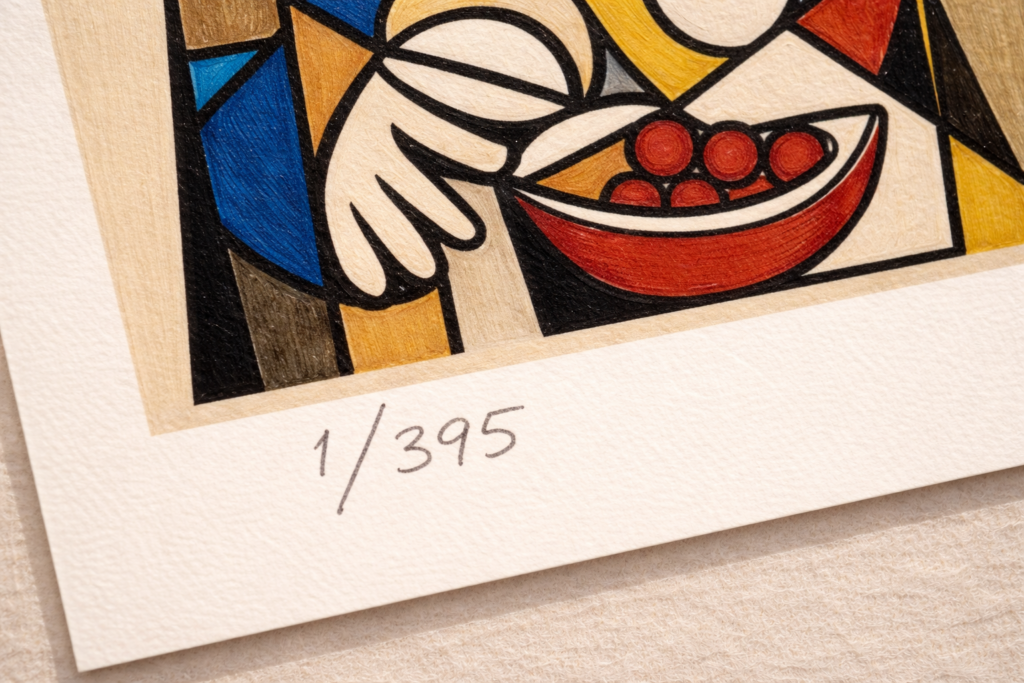
One of the most common questions new collectors ask is, “What does that fraction on a fine print mean?” The small penciled fraction—usually found beneath the image at the lower-left margin—identifies an individual print and indicates the size of the edition. While it appears simple, the fraction is often misunderstood.
Modern Editioning Explained
When multiple impressions of a print are produced, it is standard practice to assign each one a fraction, such as 21/30. This notation means the print is number 21 from an edition declared to contain 30 prints. The fraction is typically written by the artist or publisher and serves primarily as an identification tool.
The Numerator
The top number of the fraction does not indicate the order in which the print was made. A print numbered 5/25 is not necessarily the fifth impression pulled from the plate. Instead, the numerator simply distinguishes one print from another within the edition. Although earlier impressions from a plate or stone can sometimes be of higher quality due to less wear on the matrix, the edition number itself does not reliably identify early impressions. Quality must be assessed by comparing impressions, not by reading the fraction.
The Denominator
The bottom number represents the total size of the artist’s declared edition of “like” prints—prints that are intended to be identical in all meaningful ways, including paper, inking, and signature. Importantly, the denominator does not guarantee that all prints in the edition were actually produced. Determining how many impressions were printed often requires press records, artist logs, or a catalogue raisonné.
Multiple Editions and Prints Outside the Edition
In some cases, artists—especially well-known ones—authorized more than one edition from the same plate or stone. These editions might differ by paper type, size, or numbering style. As a result, the same image may exist in multiple editions.
Beyond the numbered edition, additional impressions are commonly produced. The most familiar are Artist’s Proofs (A.P.), which are usually identical to edition prints but marked “A.P.” instead of numbered. These typically represent no more than about ten percent of the edition size. Another designation sometimes encountered is H.C. (Hors de Commerce), meaning “not for sale,” originally intended for gifts rather than commercial sale.
Old Master Prints: A Different Tradition
Before the modern editioning system developed, printmakers did not usually declare edition sizes. Albrecht Dürer’s famous Apocalypse woodcuts illustrate this earlier approach. First published as a bound series in 1498 and again in 1511, these prints continued to be produced as demand required until the woodblocks wore out. This practice, now described as an open edition, means that print quantity was determined by demand and matrix condition rather than a fixed number.
For old master prints, value depends more on factors such as date of printing, quality of impression, condition, and historical importance. Paper type and watermarks are often more useful than numbering for determining when a print was made.
When Fractional Numbering Began
The practice of numbering prints with fractions likely began in France during the 1890s, influenced by the rare book trade. Research into the work of Toulouse-Lautrec shows that although many of his prints were numbered, the modern fraction format was rarely used. The earliest confirmed example of a fraction showing both print number and edition size dates to 1895, making it an important reference point in the history of print editioning.
Key Takeaways
The fraction on a fine print is best understood as a tool for identification and transparency, not a guarantee of rarity or print quality. While modern editioning provides helpful structure, collectors should remember that quality, condition, and documentation often matter more than the numbers themselves. For those interested in deeper study, a glossary of printmaking terms related to editions and proofs is available as a reference.
This article is based partly on this posting.